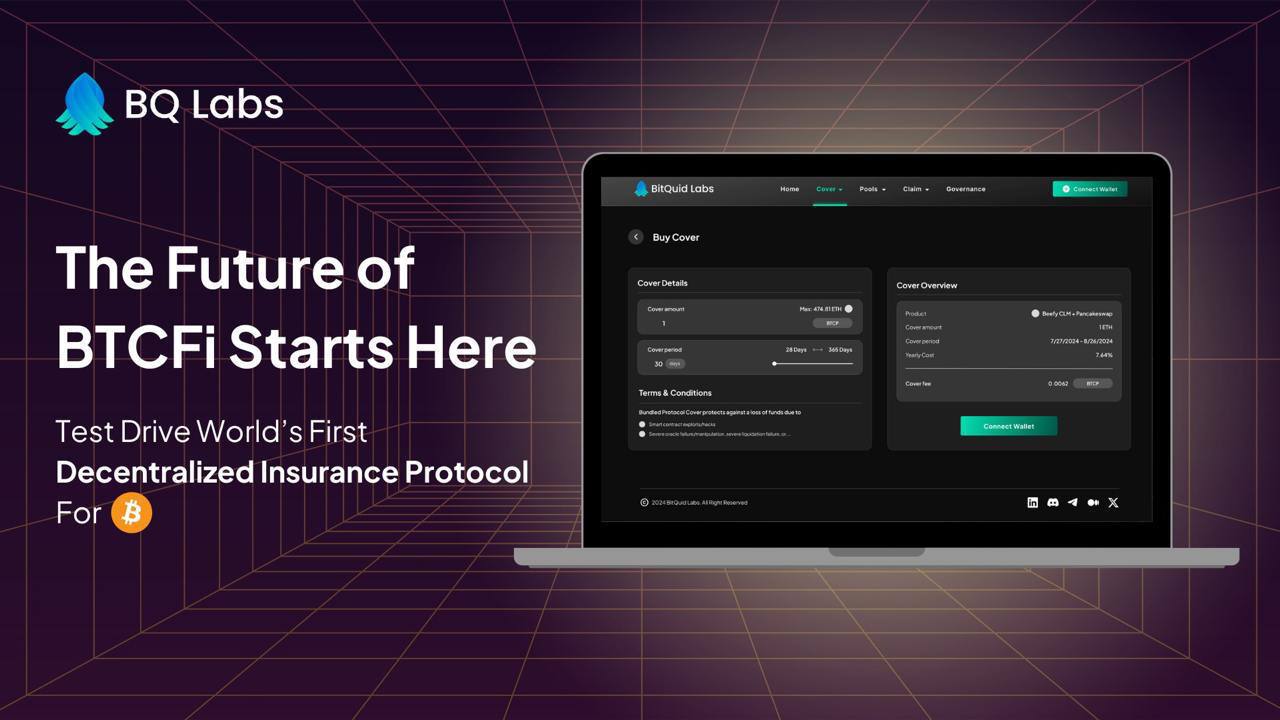
# Welcome
Welcome to the official documentation of BQ Labs, the decentralized insurance protocol designed to secure the Bitcoin ecosystem. As the first **Bitcoin Decentralized Risk Economy**, BQ Labs enables trustless underwriting, risk trading, and tailored risk coverage for assets across Bitcoin ecosystems and broader DeFi activities. With our Risk-Managed BTC Staking and BTCFi solutions, we provide sustainable returns for investors while mitigating risks. Our introduction of the **Liquid Insurance Asset Class** aims to fuel the growth of the Bitcoin ecosystem through innovative, decentralized insurance solutions.
Our mission is to drive institutional adoption of Bitcoin staking and BTCFi by building a secure, sustainable, and decentralized risk economy. We believe that robust risk management is essential for the long-term growth and stability of the Bitcoin ecosystem.
## **Join the BQ Community**
Twitter:
Linkedin:
Discord:
Telegram:
Website:
## Reach out to us
Our dedicated team is always online and ready to answer any questions you may have on [Discord](https://discord.gg/wrFmetGCa7) and [Telegram](https://t.me/+xj1JDLHhA8VhZjJl). Whether you're a Bitcoin holder looking to secure your assets or simply curious about our protocol, we're here to help. Join our community and stay updated on the latest developments and opportunities within the Bitcoin ecosystem.
# Overview
BQ Labs transforms risk management by providing a **modular and adaptive platform** that enables the creation of custom insurance pools and smooth risk trading across the Bitcoin and Layer 2 ecosystems. Designed to foster transparent governance and dynamic liquidity, the protocol empowers participants—sponsors, stakers, and proposers—to engage actively in decentralized insurance. With **flexible coverage solutions** and decentralized decision-making, BQ Labs offers users the tools to mitigate risks confidently while driving sustainable financial innovation within the Bitcoin ecosystem.
# Risk in the Bitcoin Ecosystem
The Bitcoin ecosystem is evolving rapidly, with innovations like BTCFi, Bitcoin Layer 2 (L2) solutions, and native staking protocols expanding its utility in decentralized finance (DeFi). However, these advancements introduce various risks that must be carefully managed to ensure sustainable growth.
To better address these challenges, risks within the Bitcoin ecosystem can be broadly divided into two key categories:
1. **Economic Risks**
* Slashing Penalties: Loss of funds due to non-compliance or validator failures in staking protocols.
* Wrapped Bitcoin Assets: Potential vulnerabilities or mismanagement in synthetic Bitcoin-backed tokens.
* Stablecoin Depegging: The risk of a stablecoin losing its intended peg, impacting collateralized Bitcoin and DeFi operations.
2. **Technical Risks**
* Hacks and Exploits: Attacks targeting smart contracts, bridges, or protocols.
* Security Breaches: Unauthorized access or vulnerabilities in blockchain infrastructure.
* Governance Risks: Protocols failing due to flaws in decentralized governance mechanisms or malicious proposals.
At BQ Labs, we prioritize economic risks first, recognizing their immediate impact on the confidence of Bitcoin holders and institutional participants. Our initial focus is on providing coverage for slashing penalties, wrapped Bitcoin risks, and stablecoin depegging. These are critical areas that align with the needs of risk-averse Bitcoin participants seeking downside protection.
As the platform grows, we will extend coverage to technical risks, addressing vulnerabilities from hacks, exploits, and governance failures. This phased approach ensures that we build a sustainable, reliable insurance ecosystem, starting with the most pressing risks and evolving in response to the broader needs of the Bitcoin and DeFi communities.
# Risk Management with BQ
Current decentralized insurance protocols struggle with several critical issues. **Capital inefficiency** forces users to lock their funds in long-term contracts, restricting flexibility and leaving them vulnerable to market shifts. This creates significant **illiquidity**, as participants are unable to adjust or exit their positions. Additionally, many platforms offer generic coverage that doesn’t address individual risk needs, forcing users into a one-size-fits-all approach. Slow governance and delayed claims processes further undermine user confidence, making these platforms less effective for serious risk management.
BQ Labs offers a transformative approach to these challenges. With a focus on **user-centric design**, it allows users to tailor their coverage to specific risks, providing a solution that meets individual/institutional needs rather than being forced to choose from generic templated covers. BQ Labs empowers users with more control over their risk strategy, enabling them to react quickly to market changes and manage their risk exposure dynamically through a tailor-made dashboard. The platform emphasizes **efficiency**, **transparency**, and a **streamlined experience**, offering a significantly improved alternative to traditional decentralized insurance.
By addressing the core limitations of existing models, BQ Labs sets a new standard in risk management. It empowers users with the tools and flexibility to protect their assets effectively, building the foundation for broader confidence and adoption in the Bitcoin and DeFi ecosystems.
# Core Components
This section offers a high-level overview of the key components that power the BQ Labs ecosystem, setting the stage for a deeper exploration of each in the upcoming sections. These core modules form the backbone of our decentralized risk management platform, delivering flexibility, transparency, and innovative insurance solutions tailored to the evolving needs of Bitcoin and DeFi participants.
**1. Risk Infrastructure**
BQ Labs provides a flexible **Risk Infrastructure** where **Sponsors** (lead insurers) can create custom insurance pools. Sponsors select the assets and risks they want to cover, allowing them to design tailored insurance products that align with their specific risk strategies. This decentralized structure is further supported by **Stakers**, who supply liquidity to these pools and earn rewards while enabling robust risk coverage. This approach ensures that both sponsors and stakers can participate actively in managing risk, with the flexibility to define their own terms and coverage.
**2. Liquid Insurance Tokens (LITs)**
A key innovation in BQ Labs is the introduction of **Liquid Insurance Tokens (LITs)**, which unlock liquidity for traditionally illiquid insurance products. LITs allow users to trade or sell their insurance positions on secondary markets, giving participants the freedom to adjust or exit their coverage without locking up capital for extended periods. This creates a more dynamic and efficient insurance market, empowering users to manage risk exposure with greater flexibility.
**3. Proposer Role**
**Proposers** are institutions, protocols, or retail investors purchasing insurance to protect their Bitcoin and DeFi assets from economic and technical risks. They select coverage from available pools, paying premiums for tailored protection. Proposers not only secure their positions but also contribute to pool sustainability and asset diversity, aligning coverage with their specific risk management needs.
**4. One-Click Insurance & SDK**
To simplify the insurance process, BQ Labs offers a **One-Click Insurance** feature, enabling users to purchase coverage with ease. This streamlined process reduces the complexity of buying insurance, making it accessible to all, from newcomers to DeFi veterans. Additionally, BQ Labs provides an SDK that allows developers to seamlessly integrate BQ’s insurance solutions into their applications, extending the platform’s reach across the broader DeFi space. This user-focused approach makes obtaining insurance fast, simple, and efficient.
**5. BQ Chain**
The BQ Chain is the decentralized infrastructure that underpins the entire BQ Labs ecosystem. It ensures transparency and immutability, enabling trustless transactions and decentralized governance. Through on-chain governance, participants vote on key protocol updates, ensuring the community plays a central role in decision-making. This blockchain foundation provides the security and transparency needed for a trustworthy decentralized insurance platform.
**6. BQ Risk Assessment and Analysis**
BQ Labs employs a sophisticated **Risk Assessment** and **Analysis Engine** powered by machine learning and real-time data. This system continuously evaluates both on-chain and off-chain data to provide dynamic, data-driven risk assessments. By accurately pricing premiums and adjusting coverage based on real-time conditions, BQ Labs ensures that the insurance pools remain secure and adaptable to evolving risks. This intelligent risk management engine is at the heart of BQ Labs’ ability to offer efficient and reliable coverage.
# Platform Participants
**Sponsors (Lead Underwriters)**
Sponsors act as the lead underwriters, responsible for creating and managing insurance pools. They must be accredited investors, such as:
* Layer 2 protocols offering insurance for staking and network activities.
* Institutions like asset managers and venture funds looking to mitigate risks.
* Liquid funds seeking to underwrite risks for competitive yields.
Sponsors define the coverage parameters, select the assets and risks to insure, and attract stakers through APYs. They play a vital role in sustaining the insurance ecosystem by managing capital effectively and ensuring coverage aligns with market needs.
**Stakers (Liquidity Providers)**
Stakers supply liquidity to insurance pools, backing the risks underwritten by sponsors. Any liquidity provider (LP) whether a retail investor or institution can participate, earning APY and Liquid Insurance Tokens (LITs). These LITs represent their stake in the pool and can be traded on secondary markets, giving stakers flexibility to exit or rebalance their positions. Stakers are not involved in governance, claims assessments, or investment decisions. Their role is focused solely on providing capital and earning passive income through pool participation.
**Proposers (Insurance Buyers)**
Proposers purchase insurance to protect their Bitcoin and DeFi positions from risks like slashing, bridge exploits, and stablecoin depegging. They can be retail investors, DeFi protocols, or institutions.
* Retail users securing personal Bitcoin holdings.
* Protocols ensuring liquidity pools or staking activities.
* Institutions managing large-scale risk exposure within Bitcoin L2 networks.
By paying premiums, proposers help maintain the sustainability of insurance pools and benefit from tailored coverage aligned with their specific needs.
**Risk Assessment DAO**
The Risk Assessment DAO plays a key role in governance and claims processing. It consists of security experts and risk analysts who manage claim evaluations and oversee key decisions related to risk assessment. This decentralized body ensures that claims are handled fairly and transparently, with an incentive-driven model that rewards accurate assessments.
# BQ Protocol
The BQ Protocol developed by BQ Labs is a decentralized insurance solution that fundamentally redefines risk management for the Bitcoin ecosystem. Designed to mitigate a wide array of risks such as smart contract vulnerabilities, slashing incidents, wrapped bitcoin assets, stablecoin depegging, and bridge exploits, it offers comprehensive insurance products that enhance both individual security and the broader resilience of the Bitcoin network.
At the core of BQ protocol is its **Risk Infrastructure**, where Sponsors create custom insurance pools. These pools are tailored to specific assets and risks, allowing sponsors to define coverage terms based on their own needs. Stakers provide liquidity to these pools in return for Liquid Insurance Tokens (LITs), which transforms insurance as a liquid asset class, where underwriters can trade the LITs pegged to their insurance pools across DeFi and get additional yield and restaking rewards. Proposers or Cover buyers, can purchase customized coverage to protect their Bitcoin-related activities, from DeFi projects to Bitcoin Layer 2 solutions. The process is simple: users connect their wallets, and acquire coverage through an intuitive interface. TIn the event of a claim, the DAO’s Risk Assessment team conducts a thorough evaluation, assisted by audit and risk experts who investigate claims based on on-chain as well as off-chain data. Valid claims are processed quickly, with payouts completed within three days. To ensure transparency, the protocol incentivizes challengers to scrutinize claims, rewarding them for identifying fraudulent activities, thus promoting a system of accountability.
BQ Labs’ insurance solutions extend beyond individual projects, offering coverage across the entire Bitcoin ecosystem, including Layer 2 platforms, DeFi projects, and stablecoin protocols. By continuously adapting to the evolving needs of the Bitcoin network, BQ Labs provides a flexible, secure, and efficient insurance model that sets a new standard for decentralized risk management.
This protocol not only offers protection but also fosters a trust-based ecosystem, empowering participants to engage confidently in Bitcoin’s growing financial landscape.
# Risk Infrastructure
The Risk Infrastructure of BQ Labs is a modular and composable framework that leverages several core functions of the BQ Protocol, including the **BQ Chain**, **Risk Analysis**, **Premium Pricing Framework**, and **Risk Scoring** for different cover products. This architecture is designed to provide a flexible and robust foundation for decentralized risk management within the Bitcoin ecosystem.
At the heart of this infrastructure is the ability for Sponsor ( Lead Underwriter ) to create and manage their own **customized risk pools.** BQ Labs provides both the technical and legal framework required for sponsor to define specific coverage parameters, select assets, and build pools that align with their risk strategies. Sponsor can set tailored risk profiles for their pools, ensuring that each pool is designed to cover the exact risks relevant to its participants, whether those risks are related to Bitcoin Layer 2 solutions, stablecoins, or other DeFi projects.
The Risk Infrastructure also integrates BQ Labs' Premium Pricing Framework and Risk Scoring System, enabling precise risk assessment and dynamic premium adjustments. The Risk Engine continuously monitors various on-chain and off-chain factors, providing real-time data to adjust risk levels and premium rates. This ensures that pools remain solvent, while proposers are offered competitive and accurately priced coverage.
As we continue through the BQ Labs documentation, we will delve deeper into several key components that enhance this infrastructure, including insights into unique characteristics of sponsor, and the innovative use of LITs. These upcoming sections will offer a thorough understanding of how BQ Labs delivers a dynamic, efficient, and decentralized risk management solution tailored to the growing needs of the Bitcoin and DeFi ecosystems.
# Sponsor: The Pillars of Risk Management
These **accredited entities** leverage the full power of the BQ Risk Infrastructure, enabling them to create legally compliant pools tailored to their specific risk profiles and strategies. By doing so, Sponsor plays a crucial role in driving risk management within the Bitcoin and DeFi ecosystems, offering a dynamic and adaptable approach to insurance.
Sponsor has the flexibility to select the base assets for securing their pools—whether it’s Bitcoin, project-specific tokens, or Liquid Staking Tokens (LSTs)—and define the Annual Percentage Yield (APY) for investors. They can choose from predefined risk and APY templates or build custom pools, selecting specific risks and asset classes that align with their vision. This allows Sponsor to craft unique insurance products that not only cover a broad range of risks but also provide attractive earning opportunities for liquidity providers and stakers.
Once a sponsor sets up a new pool, it is listed in the BQ Marketplace, where it can attract liquidity and participation from the broader ecosystem. Sponsor also has the ability to assign their own **Liquid Insurance Token (LIT) ticker**, providing a tradable asset that represents stakers’ contributions. This flexibility transforms the traditional insurance model, making it more fluid and capital-efficient, while offering participants enhanced liquidity and yield opportunities.
By introducing Sponsor, BQ Labs opens up an entirely new economic validation service within the insurance and investment landscape. This framework enables Sponsor to manage risk more effectively while generating substantial earning potential. Curators of these pools can maximize their returns by managing risk exposure, offering competitive yields, and fostering liquidity within their pools, all while contributing to the security of the ecosystem.
For instance, protocols like **Bitcoin LRT/LST (xyzBTC)** can be used as underwriting capital in a sponsor pool, unlocking new yield opportunities for token holders. Participants in these pools not only benefit from the yield generated but also receive Liquid Insurance Tokens (LITs), which can be used in DeFi markets, adding liquidity and tradability to their holdings.
Through the risk infrastructure framework, BQ Labs introduces an innovative approach to decentralized insurance, transforming how risk is managed and offering unprecedented financial and strategic opportunities for Sponsor. This evolution provides both flexibility and reward potential, positioning Sponsor as a key driver of growth in the Bitcoin and DeFi ecosystems.
Any interesting projects, LRT/LST protocols wishing to be part of risk infrastructure, please reach out to us via[ Telegram](https://t.me/+xj1JDLHhA8VhZjJl) or[ Discord](https://discord.gg/GzC7DZDN).
# One-Click Insurance: Simple and Fast Protection
**One-Click Insurance** by BQ Labs revolutionizes how users interact with decentralized insurance by integrating seamless, one-click insurance purchases directly within DeFi platforms. Through the One-Click Insurance SDK, platforms can offer users the ability to easily secure their transactions with insurance, eliminating the need to navigate multiple interfaces or third-party services. This feature streamlines the insurance process, making it intuitive, secure, and hassle-free.
The **One-Click Insurance SDK** is designed to be **modular**, **composable**, and **highly secure**. It allows each platform to offer insurance products specifically tailored to the risks associated with its own services, such as staking, lending, or liquidity provision. By isolating the insurance purchase from the core platform activities, the SDK ensures that each platform’s operations remain unaffected, while still providing robust protection for users. Premiums can be paid using the same assets involved in the DeFi transaction, making the process as seamless as possible.
**For example**, if a platform like Babylon integrates the SDK, users can purchase insurance directly while staking, with just a checkbox. The insurance premium is paid using the same asset being staked, making the entire experience frictionless. This gives users peace of mind, knowing that their transactions are insured without needing to leave the platform or switch to external insurance providers.
One-Click Insurance also enhances the overall platform experience by building trust and confidence. Users are more likely to engage with a platform that offers integrated insurance options, knowing that their assets are protected. For platforms, this means increased user retention, greater trust, and a more competitive edge in the rapidly growing DeFi landscape. Additionally, users have access to the BQ Labs dashboard, where they can manage policies, submit claims, and handle queries efficiently. Claims are processed through smart contracts, ensuring that payouts are automated and swift when predefined conditions are met. This further enhances user satisfaction by reducing delays and making the claims process transparent and reliable.
As BQ Labs expands its SDK integration across more platforms, this one-click insurance model is poised to become the standard for securing DeFi activities, transforming the decentralized insurance landscape for both platforms and users alike. More detailed technical documentation about the One-Click Insurance SDK will be released soon.
# The Insurance Marketplace
The Insurance Marketplace in BQ Labs is a decentralized platform where insurance products created through the Risk Infrastructure are listed and traded. It serves as the central hub for Stakers and Proposers, providing a transparent, efficient, and liquid interface for participants to interact with BQ Labs’ insurance offerings. This marketplace not only facilitates insurance policy purchases but also enables liquidity provision through staking, underpinned by advanced risk analysis and smart contract automation.
**Decentralized Listing and Trading**
The marketplace operates on a decentralized protocol that verifies and lists insurance products, ensuring all offerings meet platform standards. This decentralized approach guarantees trust and compliance, allowing for seamless and secure interactions. Smart contracts play a key role in facilitating all transactions, including policy purchases, premium payments, and claim submissions. This trustless automation minimizes manual intervention, ensuring a smooth and reliable process for all users.
**User Interface and Experience**
The marketplace features an intuitive dashboard where participants can easily view available insurance products, assess risk profiles, and make informed decisions. Real-time updates on policy status, premium changes, and risk assessments keep users informed and responsive to market changes. This real-time interactivity empowers participants to dynamically adjust their strategies, ensuring that they remain flexible in an ever-evolving ecosystem.
**Liquidity and Trading Mechanisms**
Stakers contribute liquidity to insurance pools by staking assets in return for yields, selecting pools based on Annual Percentage Yield (APY) and risk profiles. The marketplace supports dynamic staking, allowing stakers to manage their exposure and maximize returns. Participants receive Liquid Insurance Tokens (LITs), which represent their stake in the pool. LITs can be traded on secondary markets, adding liquidity and flexibility to the insurance products. This feature allows participants to enter and exit positions more fluidly, avoiding the capital lock-ups typically associated with traditional insurance.
**Claims Process and Resolution**
Proposers can submit claims directly through the marketplace interface, triggering a decentralized review process. For parametric insurance products, claims are processed automatically via smart contracts when predefined conditions are met, ensuring quick and efficient payouts. Standard claims are reviewed by the Risk Assessment DAO, a decentralized group of validators who assess the legitimacy of the claim using real-time data. This ensures a fair, transparent, and timely resolution process for all participants.
**Benefits for Stakers and Proposers**
The marketplace offers key benefits for both stakers and proposers. Risk diversification allows participants to select from a wide range of insurance products tailored to different needs, from smart contract vulnerabilities to slashing incidents and stablecoin depegging. The ability to trade LITs introduces greater liquidity and flexibility, enabling participants to adjust their positions or exit when necessary. The BQ Risk Engine further enhances the marketplace by ensuring that premiums are competitively priced, reflecting real-time market and risk conditions.
# Risk Analysis
Risk analysis is a cornerstone of the BQ Labs Protocol, designed to provide accurate, data-driven insights into the risks associated with insurance pools within the Bitcoin and DeFi ecosystems. Leveraging advanced machine learning algorithms and real-time data inputs, BQ Labs' Risk Engine continuously evaluates and adapts to the evolving risk landscape, ensuring that all pools are managed with precision, efficiency, and security.
**Dynamic Risk Assessment**
The Risk Engine operates in real-time, conducting dynamic risk assessments by analyzing multiple critical factors:
* Market Volatility: Price fluctuations of key assets like Bitcoin, stablecoins, and other DeFi tokens are continuously monitored. The engine accounts for sudden market swings, ensuring premium pricing reflects the current volatility and minimizing the chances of pool insolvency due to unpredictable market conditions.
* Protocol Vulnerabilities: As DeFi protocols expand, security risks increase. The Risk Engine assesses the integrity of smart contracts, identifying potential vulnerabilities that could lead to exploits or failures. This proactive approach ensures that protocols with higher security risks are accurately reflected in the insurance premiums.
* Historical Data and Incident Analysis: The system incorporates historical data from previous incidents, such as contract exploits, bridge hacks, and slashing events. By analyzing these occurrences, BQ Labs anticipates potential risks and adjusts coverage terms and premiums accordingly.
* Correlation Analysis: To prevent systemic risk, the Risk Engine examines the interdependencies between assets and protocols. This ensures that a single event doesn’t trigger a cascade of failures across multiple pools, safeguarding pool solvency and the wider insurance ecosystem.
**Premium Pricing**
The output of the Risk Analysis is directly tied to premium pricing. BQ Labs uses an adaptive pricing model where premiums are dynamically adjusted based on the assessed risks. For higher-risk protocols or volatile markets, premiums are set higher to protect liquidity providers and ensure pool solvency. Conversely, protocols with strong security measures and lower risks benefit from reduced premiums, making coverage accessible while maintaining the balance of risk and reward. This dynamic pricing ensures fairness and reflects the real-time risk landscape, offering Proposers competitive coverage while safeguarding Stakers and Sponsor.
Actuarial Modelling: We blend on-chain risk expertise with TradFi actuarial models. We’re leveraging stochastic modelling techniques like **Geometric Brownian Motion (GBM)** for initial risk modelling. These models will be stress-tested against levers such as BTC price fluctuations, correlated slashing events, and mass withdrawals. Over time, real-time statistical data will allow the model to evolve dynamically and refine premium pricing.
**Risk Scoring System**
BQ Labs utilizes a Risk Scoring System to provide transparency and insight into the potential risk of each pool, asset, and protocol:
* Sponsor rely on these risk scores to structure their pools appropriately, adjusting coverage based on the risk profile.
* Stakers use the risk scores and credit rating of pools to evaluate the pools before committing their assets, balancing potential yields with their risk tolerance.
* Proposers consult the scores to make informed decisions about purchasing coverage, choosing policies that align with their risk management needs.
These scores are constantly updated as new data streams into the Risk Engine, ensuring that participants always have the most accurate and up-to-date risk information at their disposal.
**Ensuring Pool Solvency and Stability**
A critical objective of BQ Labs' Risk Analysis is to maintain the solvency of insurance pools. The Risk Engine constantly tracks liquidity levels, capital reserves, and claims activity to ensure that pools have enough capital to cover potential payouts. If the risk environment changes or a pool becomes vulnerable, the engine can automatically recommend adjustments to liquidity requirements or premium structures to prevent insolvency. This proactive approach not only protects participants but also ensures the long-term stability and profitability of the platform.
Through Risk Analysis, BQ Labs creates a foundation for reliable, secure, and adaptable risk management. The Risk Engine provides real-time insights, accurate premium pricing, and dynamic risk scoring, giving participants the tools to navigate the risks associated with Bitcoin and DeFi with confidence. The continuous monitoring and adaptive management capabilities ensure that pools remain solvent and resilient, safeguarding the interests of both Stakers and Proposers.
In the coming months, BQ Labs will publish a detailed research paper that explores the mathematical framework behind the premium pricing model and the data analysis techniques driving the Risk Engine. Stay tuned for a deeper dive into how BQ Labs is pushing the boundaries of decentralized insurance through advanced risk modeling.
# BQ Chain
The BQ Chain is the core infrastructure of the BQ Protocol, designed to provide a trustless, decentralized platform for delivering insurance and financial services within the Bitcoin ecosystem. Built on the Polkadot Substrate framework, the BQ Chain integrates key stakeholders such as liquidity providers, underwriters, and insurance seekers. It enables secure, scalable operations while managing the protocol’s essential components, including underwriting capital, cover purchases, and decentralized governance.
The app chain plays a crucial role in fulfilling BQ Labs' business objectives by ensuring transparency, security, and operational efficiency. Its architecture allows for trustless operations, ensuring that all actions and decisions within the protocol are executed fairly and transparently.
**Secure and Trustless Operations**
The BQ Chain's primary function is to make the protocol fully decentralized and trustless. To achieve this, it splits the key shares of the addresses holding underwriting capital. This means that no single entity or individual controls the capital in the insurance pools, ensuring the integrity of the system and eliminating any single point of failure. By decentralizing control, BQ Labs ensures that all stakeholders, including liquidity providers and underwriters, can confidently participate in the protocol, knowing the system is fully decentralized and secure.
The underwriting pool communication logic is deployed directly on the app chain to further enhance security. This ensures that all operations related to underwriting capital are managed securely within the chain, minimizing the risk of external attacks or manipulation. By integrating these critical operations directly onto the BQ Chain, BQ Labs provides a secure and trustless foundation for its insurance products.
Additionally, while cover purchase contracts can be deployed across multiple blockchains, the BQ Chain consolidates fragmented liquidity back to its core. This approach allows the protocol to handle liquidity across different chains while ensuring efficient and secure operations. By centralizing liquidity management, BQ Labs optimizes the use of capital and ensures that underwriting and claim processes remain smooth and secure.
**Decentralized Governance and Decision-Making**
The BQ Chain also serves as the platform for decentralized governance within the protocol. Major decisions—such as protocol upgrades, changes to coverage parameters, and strategic direction—are voted on through the app chain. This governance model follows a consortium structure, where stakeholders, including liquidity providers, underwriters, developers, and advisors, collaborate in decision-making.
The decentralized nature of the BQ Chain ensures that governance is inclusive, transparent, and representative of all parties involved. By distributing decision-making power among a diverse group of participants, BQ Labs guarantees that the protocol evolves in a way that reflects the interests and needs of the entire ecosystem. This collaborative governance framework, combined with the transparency of the app chain, ensures that all critical decisions are executed fairly and efficiently.
**Enabling Innovation and Development**
The BQ Chain is not only a backbone for current operations but also a platform for future innovation. Developers can build new products and services on top of the app chain, leveraging its robust, scalable infrastructure. This includes creating new insurance products, such as Liquid Representative Token (LRT)-based pools or custom underwriting pools tailored to specific risks. The flexibility of the BQ Chain allows developers to explore new insurance solutions, expanding the protocol’s capabilities and offerings.
By opening the BQ Chain for third-party development, BQ Labs is creating a broader ecosystem where new decentralized insurance solutions can thrive. The app chain’s modular design ensures that products built on top of the protocol can seamlessly integrate with existing operations, further driving the growth of decentralized insurance products in the Bitcoin and DeFi spaces.
# Technical Architecture
The BQ Protocol Layer is a decentralized, secure platform designed to support innovative insurance and financial solutions within the Bitcoin ecosystem. Leveraging the Polkadot Substrate framework, this architecture combines cutting-edge cryptographic techniques with decentralized governance and seamless cross-chain operations to offer a highly scalable and trustless environment. The platform's design incorporates advanced technologies such as the Threshold Signature Scheme (TSS), on-demand parachains, and cross-chain liquidity management, making it a robust infrastructure for decentralized insurance.
The following sections break down the key components of this architecture, highlighting how they work together to create a transparent, secure, and efficient system.
**Key Components**
1. **Nodes and Threshold Signature Scheme (TSS)**
At the heart of the BQ Protocol’s architecture are its nodes, responsible for validating transactions, securing capital, and maintaining network consensus. Each node operates within the Threshold Signature Scheme (TSS) framework, a cryptographic method that distributes control over private keys across multiple nodes. This prevents any single node from holding complete control, thereby mitigating risks of centralization and enhancing security.
In TSS, each node holds a share of the private key. When an external action triggers a transaction (as seen in the diagram), nodes detect this action and begin the signature share submission process. Only when a threshold number of nodes (typically a majority) approves the transaction, can a full signature be generated. The final transaction is then broadcast to the blockchain, ensuring that no individual node can act unilaterally. This decentralized signing mechanism ensures that control is evenly distributed, protecting the protocol from single points of failure.
2. **Parachain for Secure and Efficient Operations**
The parachain serves as the operational backbone of the BQ Protocol, facilitating core processes such as state management, staking, and transaction verification. The on-demand parachain, shown in the diagram, is responsible for tracking and consolidating transactions across nodes while securing the insurance pools and managing liquidity.
One of the key advantages of the parachain is its role in managing the staking and slashing mechanism. Nodes are required to stake tokens to participate in the network, incentivizing honest behavior and ensuring that the network remains secure. If a node acts maliciously or fails to validate transactions properly, their stake is slashed—serving as a deterrent against bad actors. This system of penalties and rewards guarantees the integrity and reliability of the network, as nodes are financially motivated to act in the network’s best interest.
Additionally, while insurance contracts can be deployed across multiple chains, the parachain consolidates fragmented liquidity back to a central point. This allows the BQ Protocol to operate across different blockchains while ensuring liquidity is efficiently managed and secured on the parachain. This design enables cross-chain interoperability, allowing the platform to support multiple blockchains while maintaining a unified liquidity pool for underwriting and claims management.
3. **Collators and Block Production**
Collators play a pivotal role in ensuring the smooth operation of the parachain by aggregating transactions from nodes and producing new blocks. Collators validate transactions, confirm signatures, and produce candidate blocks, which are then added to the chain. In the diagram, collators help ensure that every transaction—once verified by the nodes—meets the required consensus before it is included in the blockchain.
Collators are critical to maintaining the high performance and efficiency of the parachain. They ensure that block production happens at low latency and with high throughput, making sure that the system can handle a large volume of transactions without compromising on security or speed. Their reliability is incentivized through rewards, ensuring that only trusted participants maintain the health and performance of the network.
**Staking, Slashing, and Governance**
In the BQ Protocol Layer, staking ensures that nodes are committed to maintaining the protocol’s integrity. Nodes stake tokens to participate in the network, and their participation earns them rewards. However, if a node misbehaves—by submitting invalid transactions or failing to validate correctly—it risks having its stake slashed, a penalty that ensures accountability. This mechanism protects the network from potential attacks and encourages honest participation.
The protocol also incorporates a decentralized governance model. Through governance, nodes and stakeholders vote on key decisions that affect the protocol, such as adjusting coverage parameters, upgrading contracts, and making changes to the insurance pools. By distributing governance power across multiple stakeholders, the protocol ensures transparency, inclusivity, and fairness in its decision-making processes.
**Cross-Chain Interoperability and Liquidity Management**
The BQ Protocol Layer is built with cross-chain interoperability in mind, leveraging the capabilities of the Polkadot Substrate framework. This allows the protocol to interact with multiple blockchains while maintaining a secure and efficient liquidity management system.
Insurance contracts can be deployed on different chains (e.g., Ethereum, Bitcoin L2s), while liquidity is consolidated on the BQ parachain. This ensures that underwriting capital is efficiently utilized across chains, enabling seamless cross-chain claims payouts and premium management. By leveraging cross-chain capabilities, BQ Labs provides a scalable, interoperable solution for decentralized insurance that can adapt to the evolving needs of the Bitcoin and DeFi ecosystems.
The Technical Architecture of the BQ Protocol Layer is built for scalability, security, and interoperability. The integration of Threshold Signature Scheme (TSS) ensures decentralized control over transaction validation, preventing any single point of failure. The parachain serves as the operational core, handling staking, slashing, and liquidity management while providing cross-chain interoperability. Collators ensure the system's performance by maintaining block production and validating transactions.
With a combination of decentralized governance, advanced cryptographic techniques, and multi-chain support, the BQ Protocol Layer is designed to meet the growing needs of decentralized insurance solutions. This sophisticated architecture ensures that BQ Labs remains at the forefront of the Bitcoin and DeFi ecosystems, delivering trustless, secure, and efficient insurance services across multiple blockchain networks.
# User Journey through BQ Labs
The BQ Labs platform offers a seamless, decentralized process for various participants, including Sponsor, Stakers, and Proposers, enabling them to easily create, stake in, or purchase insurance products. This user flow illustrates how each persona interacts with the platform, highlighting the efficiency, transparency, and security built into the system.
**Sponsor Persona: Sarah**
Scenario: Sarah, a representative from a Bitcoin Layer 2 project, wants to create an insurance product.
1. **Setting Up Pools**: Sarah logs into the BQ Labs platform and creates a coverage pool. She customizes the pool by specifying important parameters such as coverage limits, digital assets to be used, and risk management rules.
2. **Raising Capital**: Sarah defines the terms for liquidity provision, inviting Stakers to contribute assets to the pool by offering attractive yields based on the risks covered.
3. **Launching the Insurance Product**: Once the pool is sufficiently funded, Sarah launches her insurance product on the Insurance Marketplace, where it becomes available for purchase by Proposers. This allows her Bitcoin Layer 2 project to gain additional security and trust by offering decentralized insurance.
Outcome: Sarah successfully creates a coverage pool, attracting liquidity providers and offering security to users of her Layer 2 project.
**Staker Persona: Bob**
Scenario: Bob, a high-net-worth individual, decides to stake his assets in a coverage pool.
1. **Connecting Wallet**: Bob logs into the BQ platform, clicks on "Connect Wallet," and chooses his preferred wallet provider, securely connecting his wallet to the platform.
2. **Selecting a Pool**: Bob navigates to the Insurance Marketplace and reviews various coverage pools. He finds a pool offering an attractive APY that aligns with his risk tolerance.
3. **Providing Liquidity**: Bob stakes his assets in the selected pool. In return, he earns LIT and participation rewards through the offered APY, which increases over time as more insurance products are sold and managed within the pool.
Outcome: Bob generates passive income by staking his assets in a decentralized insurance pool while contributing to the security of the ecosystem.
**Proposer Persona: Alice**
Scenario: Alice, a retail investor, seeks to protect her Bitcoin assets during DeFi activities.
1. **Connecting Wallet**: Alice accesses the BQ Labs platform and clicks "Connect Wallet." After selecting her wallet provider, she successfully connects her wallet and gains access to the platform.
2. **Analyzing Insurance Options**: Alice navigates to the Cover Section, where the platform analyzes her DeFi positions and Bitcoin holdings, automatically suggesting relevant insurance products that suit her needs.
3. **Purchasing Insurance**: Alice reviews the premium quotes provided by the system, selects the insurance product that best covers her risks, and purchases coverage with a simple click.
Outcome: Alice successfully secures her Bitcoin positions in the DeFi ecosystem, gaining peace of mind knowing her assets are protected from potential risks.
**Claims Process**
The BQ Labs platform offers a streamlined claims process, designed to be fair, transparent, and fast. Depending on the type of insurance purchased, claims are processed through two mechanisms:
1. **Parametric Claims**: For certain predefined events (e.g., smart contract failures, protocol exploits), claims are processed automatically via smart contracts. Once the triggering event occurs, the contract executes the payout instantly without the need for manual intervention. This ensures fast, reliable claim resolution, providing immediate protection to users like Alice.
2. **Governance-Based Claims**: For traditional insurance products, claims undergo a decentralized review process. The governance members—comprising security experts, risk analysts, and bug bounty participants—assess each claim thoroughly, ensuring it meets the predefined criteria and policy rules. This process guarantees an unbiased and fair decision. Upon approval, payouts are processed within three days, providing users with prompt compensation.
# Detailed User Flow
The BQ Labs platform provides a seamless and decentralized process for Sponsor, Stakers, and Proposers to engage with insurance products and earn yields through underwriting and investment. Each participant interacts with the platform through distinct processes that are designed for flexibility, security, and profitability. Below is a detailed breakdown of the flow for each user role.
**Sponsor’s Flow:**
Sponsor act as lead insurers, typically institutional investors, responsible for creating insurance pools and attracting liquidity.
1. Pool Creation:\
Sponsor create pools that cater to specific risks within the DeFi ecosystem. They define parameters such as coverage limits, the type of digital assets to be used (e.g., Bitcoin, ETH, stablecoins), and the kinds of risks the pool will cover. Pools may range from low-risk pools covering minor risks to high-risk pools that provide coverage for more volatile DeFi activities.
2. Raising Capital:\
Sponsor incentivize Stakers to contribute liquidity to these pools by offering competitive APYs. For instance, low-risk pools may offer a stable x% APY, while higher-risk pools offer y% to reflect increased exposure to potential claims. APYs are dynamically adjusted based on the pool’s performance and claim activity.
3. Launching the Pool:\
Once sufficient liquidity is raised, the pool is launched on the Insurance Marketplace, where Proposers can purchase coverage to protect their assets. The pool becomes active and starts underwriting risk, providing liquidity to stakers and coverage options to proposers.
**Staker’s Flow:**
Stakers provide liquidity to the insurance pools, effectively underwriting risks in exchange for yields.
1. Choosing a Pool:\
Stakers connect their wallets to the BQ platform and browse the Insurance Marketplace to select a pool based on risk and yield preferences. Pools are categorized by risk level:
* AAA Pools (low-risk, low-yield)
* BBB Pools (medium-risk, medium-yield)
* CCC Pools (high-risk, high-yield)
2. Stakers choose pools that align with their risk tolerance and desired returns. For instance, a staker might opt for a low-risk pool offering x% APY for stable returns or a high-risk pool offering y% APY for higher potential yield but greater exposure to claims.
3. Earning Yields:\
Stakers earn yield in three primary ways:
* Underwriting Income: A portion of the premiums paid by Proposers is distributed to Stakers as underwriting income. For example, x% of the total premium collected from Proposers is allocated to Stakers, with returns being more stable in low-risk pools and more volatile in high-risk pools.
* Liquid Insurance Tokens (LITs): Stakers receive LITs, which represent their share of the pool's liquidity. LITs are tradable on secondary markets, providing additional liquidity and earning opportunities for stakers. LITs can also be used in DeFi protocols, further increasing their utility.
* Investment Arm : A portion of the invested assets into the pools are invested in risk free yield earning methods to generate a substantial yield for the pools.
4. Dynamic Yields:\
The APY of a pool is dynamically adjusted based on the number of claims made against it. For example, pools with fewer claims provide more stable returns (e.g., x% APY), while pools with higher claim activity might offer reduced returns to Stakers (e.g., y% APY). This ensures that returns are sustainable while balancing risk.
**Proposer’s Flow:**
Proposers (or Cover Buyers) purchase insurance to protect their digital assets from risks such as protocol exploits, smart contract failures, or other DeFi-related risks.
1. Exploring Coverage Options:\
Proposers browse the Insurance Marketplace to evaluate the various pools available. They assess risk profiles and coverage terms, selecting pools that align with their needs. For example, a Proposer might opt for a low-risk pool charging x% premium or a high-risk pool charging y% premium depending on the protection required.
2. Purchasing Coverage:\
Once a suitable pool is identified, the Proposer purchases coverage by paying the premium, which is calculated based on factors such as the total value of the assets being insured, the risk level of the pool, and the pool’s historical claim performance. For example, insuring a large DeFi position in a high-risk pool may require a premium of y%, while a low-risk pool might charge x%.
3. Discounted Premiums for Stakers:\
Proposers who are also Stakers in the same pool may receive discounted premiums, incentivizing deeper participation in the BQ ecosystem. For example, if a Proposer is also staking in the pool, they might receive a z% discount on the insurance premium.
**Earning Yield:**
Stakers on the BQ platform benefit from a dual-income model that includes both underwriting income and investment income.
1. **Underwriting Income:**\
Stakers earn a portion of the premiums paid by Proposers as underwriting income. For instance, x% of the premium is allocated to the pool’s stakers. If the pool has fewer claims, the yield increases. However, if more claims are made, the underwriting yield decreases slightly to ensure sufficient capital is available for payouts.
2. **Investment Income:**\
A portion of the staked capital and premiums is allocated to an Investment Pool, managed by the Investment DAO. The DAO diversifies the pool’s funds across multiple asset classes to generate additional returns. For example, y% of the pool’s assets may be allocated to the investment arm, which then generates yield for stakers. The Investment DAO rebalances the portfolio dynamically to optimize returns while ensuring enough liquidity is reserved for potential claims.
BQ Labs provides an intuitive and efficient user experience for all participants—Sponsor, Stakers, and Proposers. Sponsor create insurance pools, Stakers provide liquidity and earn yields, and Proposers secure their assets through flexible coverage options. The platform’s transparent claims process and dynamic yield structure make it an attractive solution for decentralized insurance, while Liquid Insurance Tokens (LITs) offer additional liquidity and earning opportunities. With a balance between security, flexibility, and profitability, BQ Labs is setting a new standard for decentralized insurance in the Bitcoin and DeFi ecosystems.
# Devnet
**How to Use Guide for BQ Labs Devnet**
This guide provides a step-by-step walkthrough of how to use the BQ Labs devnet, currently deployed and integrated on **Bitlayer, Core, Merlin**. The devnet is currently in a closed access phase and supports desktop browsers only, with plans for support across multiple devices in future versions.
**1. Device Support**
* The current devnet version is supported only in desktop browsers.
* Future versions will expand support to multiple devices.
**2. Install Wallet**
* To use the application, users must install the supported wallet browser extension ( Metamask, Gate, Bitget, OKX )
**3. Import Testnet into MetaMask**
* Add the respective testnet to your wallet by navigating through the documentation or .
* Manually input the custom RPC details into the wallet.
**4. Get Faucet Tokens**
* To interact with the devnet, users need the respective chains native assets for gas fees.\
Bitlayer - [https://www.bitlayer.org/faucet ](https://www.bitlayer.org/faucet)Core - [https://scan.test.btcs.network/faucet ](https://scan.test.btcs.network/faucet)Merlin - Visit Merlin discord and get faucet tokens
* We have created a test version of BTC ( bqBTC ) to purchase cover, provide capital into cover and claim loss amount. Users can get bqBTC from
* Risk assessors or members who would like to be a part of this assessment can use BQ test tokens to vote for proposals. Users can get BQ from
**5. Access BQ Labs Devnet**
* The devnet can be accessed via[ BQ Labs Devnet](https://dev.bqlabs.xyz/).
* As this is a closed access devnet, users must obtain a password from the BQ Labs team or through Discord.
**Core Features and Modules**
1. **Purchase Cover Flow**
* From the navigation bar, click on the "Purchase Cover" button.
* Browse cover products based on different risk categories.
* Select a cover product and input the cover amount and duration via a slider.
* The premium price will be dynamically calculated based on the cover product.
* Click on “Buy Cover” and complete the on-chain transaction using bqBTC tokens for both premium and native chain token for gas fees.
* After purchase, users can view their existing covers under the “My Cover” section.
2. **Claim Module**
* Users can submit a claim if they face a loss event and have an active cover.
* To claim, go to "My Cover" or directly to the claim module via the navbar.
* Provide necessary details for claim assessment: claim event date, claim amount, transaction hash, and description.\
Note: For testing in devnet, random details can be used for the claim process.
* Submit the claim and complete the on-chain transaction.
* The claim status will be updated, and the claim request will be submitted to risk governance for voting. Based on voting results, users can either withdraw the claim amount or resubmit the request.
3. **Pools Module**
* Underwritten capital for cover products comes from staking pools. Users with idle assets can deposit bqBTC to earn yield and provide capital for underwriting risks.
* From the navbar, go to the “Pools” section and select the stake option from the dropdown.
* Users can view four different pools, each offering different APYs. Quick staking is available by clicking “Stake” and entering the deposit value.
* For more detailed risk distribution, users can click on "Details" for in-depth information about each pool and stake through the detailed information page.
* After staking, users can view their positions in the “My Stake” page, where they can claim yields and withdraw after the tenure period.
4. **Governance**
* Risk assessors who hold BQ Tokens in their wallets can vote on claim proposals.
* Users can obtain BQ Tokens from the faucet.
* Assessors can vote to “Accept” or “Decline” a claim proposal, determining the outcome of the claim process.
**Reference demo video**
For a step-by-step guide on how to use our platform, please refer to the demo video linked below. This video provides a comprehensive explanation of the product’s features and a detailed walkthrough of the platform.\
\
[Watch the Demo Video Here ](https://drive.google.com/file/d/1kpeSoLNYOXUYsFYTunbhZ6LUF-9sr6AH/view?usp=sharing)
**Troubleshooting**
If users face any difficulties or require support while using the application, they can reach out to the BQ Labs team via Discord for assistance.
# Key Terms
**Actuarial Data**\
Statistical data used to assess and price insurance risks.
**Annual Percentage Yield (APY)**\
The return stakers earn by providing liquidity to insurance pools.
**BQ Chain**\
The blockchain layer managing BQ Labs’ operations and governance.
**Consortium**\
A group of stakeholders overseeing governance and claims processes.
**Governance**\
The decentralized voting system for protocol decisions and claims.
**Insurance Pool**\
A pool backed by stakers, providing insurance coverage to proposers.
**LIT (Liquid Insurance Token)**\
Tradable tokens representing stakers’ share in the pool.
**Parametric Insurance**\
Automatically triggered payouts based on predefined conditions.
**Proposer**\
Users who purchase coverage to protect assets from risks.
**Risk Assessment**\
Evaluation of risks to adjust premiums and ensure pool sustainability.
**Risk Infrastructure**\
The system enabling sponsor to create pools and manage insurance.
**Slashing**\
Penalties for malicious behavior, reducing a staker’s stake.
**Sponsor**\
Lead Insurers who initiate and manage an insurance pool.
**Staker**\
A user providing liquidity to a pool in exchange for APY and LITs.
**Underwriter**\
An entity managing insurance pools and attracting stakers.
**Validators**\
Participants validating transactions and securing the BQ Chain.
# FAQ
**1. What is BQ Labs and why is it critical for Bitcoin's ecosystem?**
BQ Labs is the first decentralized insurance protocol designed for the Bitcoin ecosystem. It offers decentralized risk management solutions for Bitcoin and BTCFi activities, ensuring protection against DeFi risks, encouraging institutional Bitcoin adoption, and enabling trustless underwriting.
***
**2. How does BQ Labs manage risks in the Bitcoin Layer 2 ecosystem?**
BQ Labs provides risk management solutions for Bitcoin Layer 2 (L2) protocols. It allows users to insure their assets, including native Bitcoin staking, bridge protocols, and other BTC-related DeFi activities. Risks such as smart contract vulnerabilities, slashing, and bridge failures are mitigated using customized insurance pools that users can participate in by providing liquidity or purchasing coverage.
***
**3. What are Liquid Insurance Tokens (LITs) and how do they benefit stakers?**
LITs are tokens representing stakers’ participation in an insurance pool. They are tradable and provide liquidity without requiring stakers to exit the pool. Additionally, LITs can be used in other DeFi protocols, unlocking extra liquidity and potential earning opportunities for stakers.
***
**4. What makes parametric claims important for insurance?**
Parametric claims are automated and triggered when specific predefined events occur, such as a smart contract exploit. This removes the need for manual review, ensuring instant payouts for Proposers. Parametric claims are essential for reducing delays, improving transparency, and guaranteeing quick compensation for commonly insured risks.
***
**5. How is BQ Labs different from traditional insurance protocols?**
BQ Labs is a decentralized, trustless protocol that eliminates intermediaries and automates insurance processes through smart contracts. Unlike traditional models, BQ Labs introduces insurance as a new asset class with Liquid Insurance Tokens (LITs), enabling stakers to trade their positions and gain liquidity. The protocol also offers innovative benefits like cross-chain risk coverage and yield generation through staking, making it a more versatile and transparent insurance solution.
***
**6. What role do sponsor play in BQ Labs?**
Sponsor create custom insurance pools by setting parameters such as asset coverage, risk limits, and liquidity targets. They manage the risk and attract stakers by offering competitive APYs. Sponsor play a key role in underwriting Bitcoin DeFi activities and earning revenue from premiums collected in their pools.
***
**7. How do stakers earn yields on BQ Labs?**
Stakers earn yields by providing liquidity to insurance pools. The APY they receive is based on the performance and risk profile of the pool. Yields are dynamically adjusted based on the number of claims, the total premium collected, and pool activity, ensuring stakers are rewarded proportionally to the pool’s success.
***
**8. How does BQ Labs manage cross-chain risks in Bitcoin Layer 2?**
BQ Labs supports cross-chain interoperability within the Bitcoin Layer 2 ecosystem. Through the BQ Chain, the platform enables insurance coverage for various Bitcoin L2 protocols and manages risks across these networks. By consolidating liquidity from different pools, BQ Labs ensures efficient claims processing and seamless integration across Bitcoin-related ecosystems.
***
**9. What types of risks does BQ Labs cover?**
BQ Labs provides insurance for various risks, including:
* Wrapped Bitcoin assets
* Slashing penalties from staking
* Smart contract vulnerabilities
* Bridge exploits
* Governance failures
* Stablecoin de-pegging
This comprehensive coverage allows users to protect their Bitcoin and DeFi positions from a wide range of potential threats.
***
**10. How does BQ Labs ensure fairness in governance-based claims?**
Governance-based claims are reviewed by a team of security experts and risk analysts who specialize in evaluating DeFi risks. To ensure fairness, these experts are incentivized through a reward model tied to the accuracy and transparency of their claim assessments, promoting unbiased and efficient decision-making throughout the process.